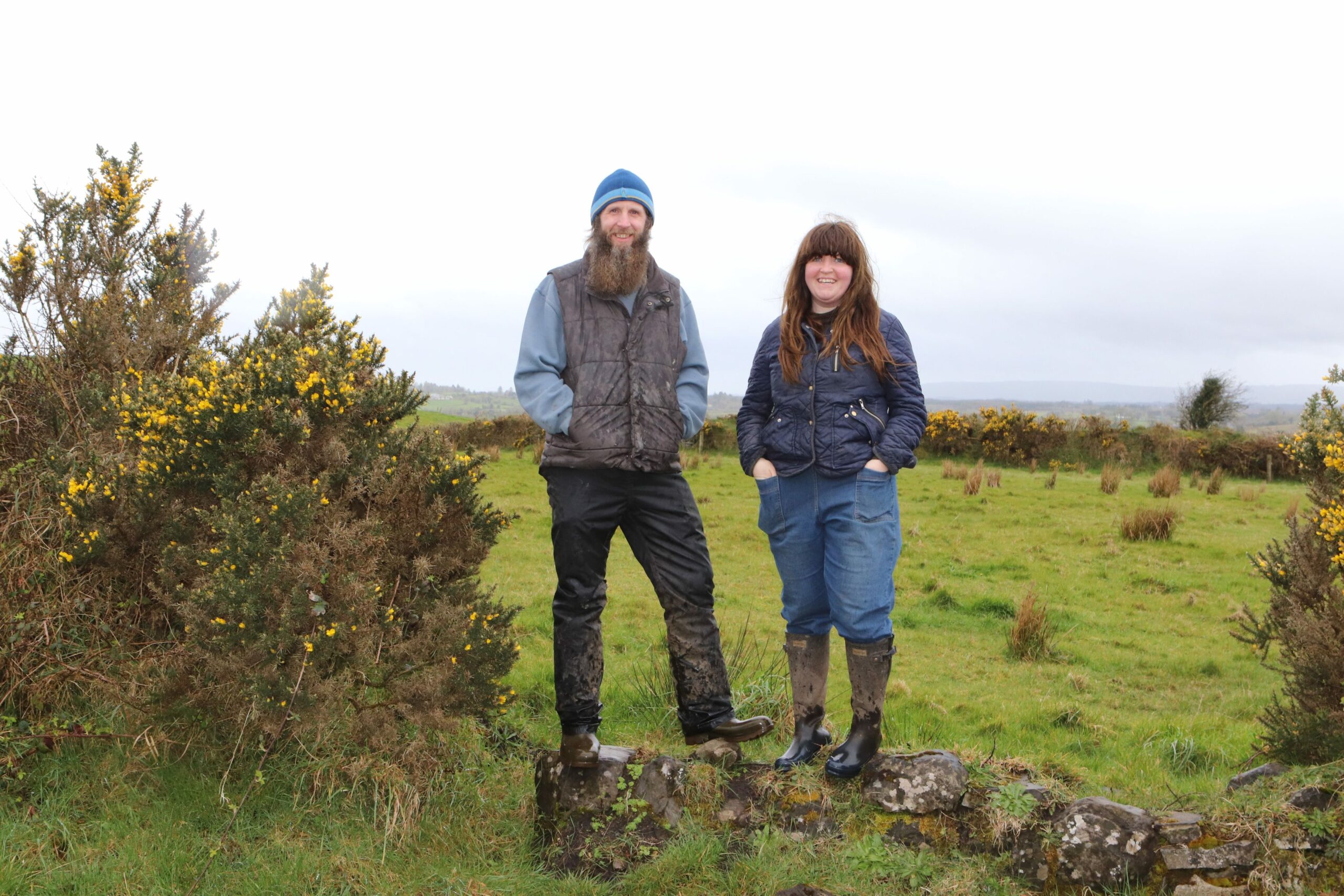


Those that know us well, know farming was not necessarily in our future. They say when life gives you lemons, make lemonade. What do you do when it gives you a meadow? Establish a micro-diary of course! OK, that doesn’t rhyme. Nor is it the usual response. But here we are, at the end of our 2nd full season, resting, recuperating and thankful. Thankful for the meadow. .
The farm we manage was never farmed intensively. Joe McHugh kept in place the old hedgerows, stone buildings, walls, grand Sycamores, apple trees and meadows that make up the place we now call Gleann Buí Farm. The name itself was passed down to us through stories about field names. Gifted the name by MJ’s great-grandparents. The Gleann Buí means the ‘yellow valley’ in English. It is a field rich in biodiversity. Made up of different grasses, grass herbs, buttercup, birdsfoots, dandelions and clovers. But that’s not how it got its name. It was christened such because when the house cow grazed that particular field many moons ago and her milk was churned for butter. It was always the richest, deepest yellow in colour.
Our return to farming life was not a direct route. Rather one formed by twists, turns, roundabouts, stories of old and new, whats ifs, environmentalism, conservationism and perhaps an urge to live slower. MJ knew he wanted to farm, he had a connection and sense of place to this land I thought I’d never understand. Having grown up on a small suckler farm, I always had a fondness for cows that didn’t necessarily translate into a desire to farm. My role growing up had been merely to ‘stand in gaps’. A few decades laters and I’m calling our own cows through gaps and down into our small parlour.
Gleann Buí Farm…
My involvement came about whilst I was writing my thesis on “Sustainable diets & the emissions reduction potential via a low to no meat and dairy diet” and MJ placed 14 heifers on the land. You can imagine the conversations over dinner! It was MJ’s arguments that the land needed cows to maintain the meadows I had come to love walking through that led me to the research on High Nature Value Farming. Based on studies out of IT Sligo, the term refers to land that remains semi-natural in habitat having been managed extensively for generations.
To farm for nature, to preserve this species rich meadow and grassland. We had to farm it extensively and organically. We re-started this process in 2015 and by 2018, decided that at our scale, having managed to control the inputs to the farm, we also needed to control its output. During that time, we’d met other farmers through the organic network, direct selling and farming ‘unconventionally’ and the story of the Gleann Buí forever remained in the back of our minds. The yellow valley that made a rich yellow butter.
In 2018 we bought a traditional shorthorn cow and milked her that summer. We farm as close to nature as possible so our cows are not fed any grains or ‘meal’. The shorthorn, for us, is the right cow in the right place. They thrive in our fields and easily convert the organic meadow into thick creamy milk without any external inputs. Thus having weighed up all the pros and cons and enjoying the company of our cows in the fields too much to give it up. We ‘broke’ ground in November 2019 on establishing our parlour and processing room.
The micro-dairy…..
A micro-dairy means we are an independent dairy farm not part of any co-opertvies, producing, bottling and selling organic raw dairy direct to people across the North-West. Our milk is fresh “teat to table”, built on short supply chains with every litre we produce sold directly to independent grocers, cafes, chefs and the local community. We run a local milk delivery service around Aghamore, Kilkelly, Ballyhaunis, Knock and surrounds. We milk once a day giving our cows plenty of time to convert all that rich pasture into rich dairy. We bottle and hand prepare everything on site, delivering the milk ourselves in a chill van. It’s full on and requires our full time attention. To operate as a pasture for life farm (meaning the cows only eat what they forage in the meadow and hedgerows) means when growth stops in November, so do we. The cows and ourselves take the winter to rest and recuperate, ready for the season to kick off again in March.
An open farm….
Since we started this journey, we’ve tried to maintain an open farm policy. Sharing every day farming life through social media, newspapers, radio interviews and short films. Last year we were nominated for the Farming for Nature Awards, receiving a Farming for Nature Ambassador title for 2020. This year we added in an education element via ‘Farmertime’. An initiative whereby we link up with a school and give them a weekly insight into farming life and what it takes to produce food. From next year, we plan to open our gate to on-farm milk collections, farm walks and tours. We’re also the local water catchment Lighthouse Farm for the year long Talamh Beo EIP (European Innovation Partnership) project about soil health, linking the health of our soil to our cows, their milk and our gut.
For now, we live slowly, ready to take on a busy 2022 season.
Hello.
Interested to know your thoughts on house cows as I’m considering maybe one or two.
I work on an organic dairy farm milking about 30 Short horns for a charitable trust making their iwn cheese and I have a small holding of a few acre. It’s the small holding I’m thinking for the house cow.
Enjoyed your website, keep up the good work.
Andrew